
Workers' compensation and disability management organizations face increasing pressure to control costs, improve outcomes, and ensure that claims and benefits are supported by objective, defensible evidence. One of the greatest challenges is determining whether an individual's reported limitations, recovery progress, and return-to-work readiness are accurate, consistent, and measurable.
The evidence gap in claims management
Traditional assessments rely heavily on subjective observation, patient self-report, and narrative clinical notes. That evidence varies by provider, varies by visit, and rarely survives review unchanged — leaving carriers, TPAs, and disability managers to make high-stakes decisions on incomplete information.
AvaSci provides carriers, TPAs, disability managers, and claims professionals with objective movement intelligence that helps identify injury risk, assess functional impairment, and detect movement inconsistencies that may warrant additional clinical review or investigation. By capturing and analyzing thousands of biomechanical data points, AvaSci delivers evidence-based insights that traditional assessments and subjective observations often miss.
Identifying high-risk cases early
In both workers' compensation and disability claims, the ability to objectively evaluate physical function can help organizations identify high-risk cases early, support more informed decision-making, and develop targeted intervention plans designed to improve outcomes while reducing costs.
Movement consistency analysis is central to this. Genuinely impaired movement tends to be reproducible — the limitation shows up the same way trial after trial. Inconsistent effort tends to drift from repetition to repetition. Quantifying both the magnitude of abnormality and the coherence of the pattern gives claims professionals a movement-quality observation that flags which results deserve a closer clinical look.
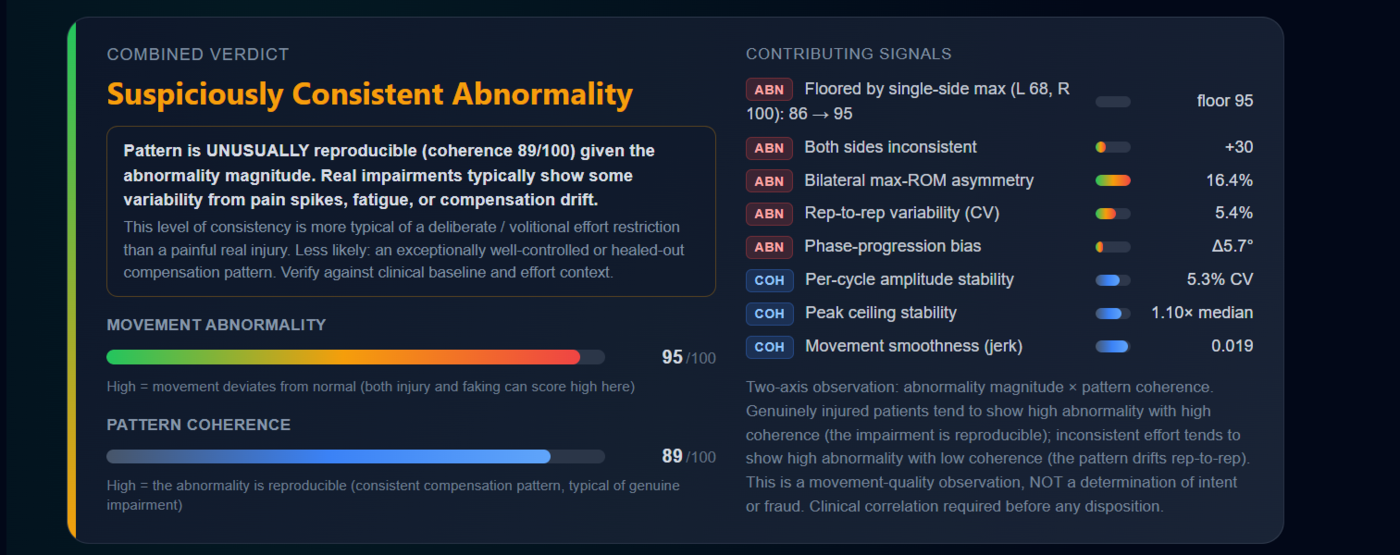
A real AvaSci consistency analysis: high movement abnormality combined with unusually high pattern coherence — the kind of result that warrants additional clinical review before any disposition.
From measurement to action
When movement inconsistencies, functional limitations, or elevated injury risks are identified, AvaSci supports the development of personalized action plans that can include rehabilitation, conditioning, ergonomic modifications, or additional clinical evaluation to optimize recovery and facilitate a safe return to work.
What administrators gain:
- Objective functional measurement — mobility, range of motion, balance, stability, symmetry, and movement quality measured with precision and consistency.
- Claims validation support — movement inconsistencies, compensation patterns, and functional performance variations that may warrant additional clinical review or investigation.
- Injury risk identification — movement deficiencies and biomechanical patterns that may contribute to injury risk, supporting preventative interventions.
- Return-to-work optimization — recovery progress tracked objectively over time, supporting evidence-based return-to-work decisions.
- Outcome measurement — measurable, repeatable data that can be compared throughout treatment, rehabilitation, and recovery.
Objective movement data doesn't replace clinical judgment — it gives every decision-maker in the claim lifecycle the same defensible, repeatable evidence to act on.